On this page 11 sections
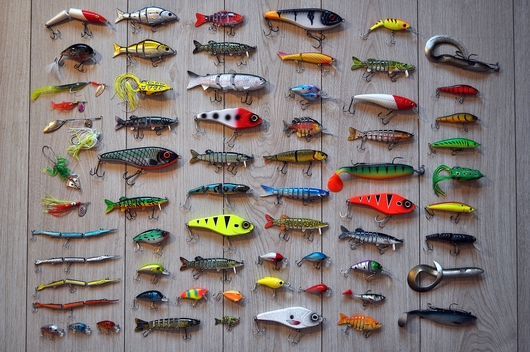
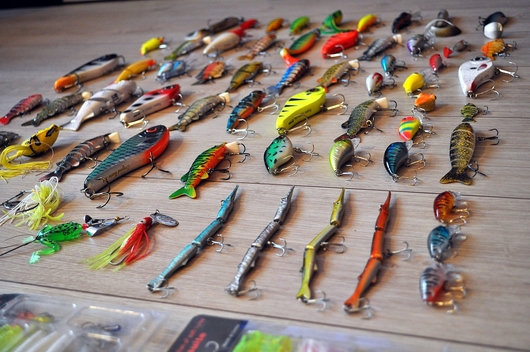
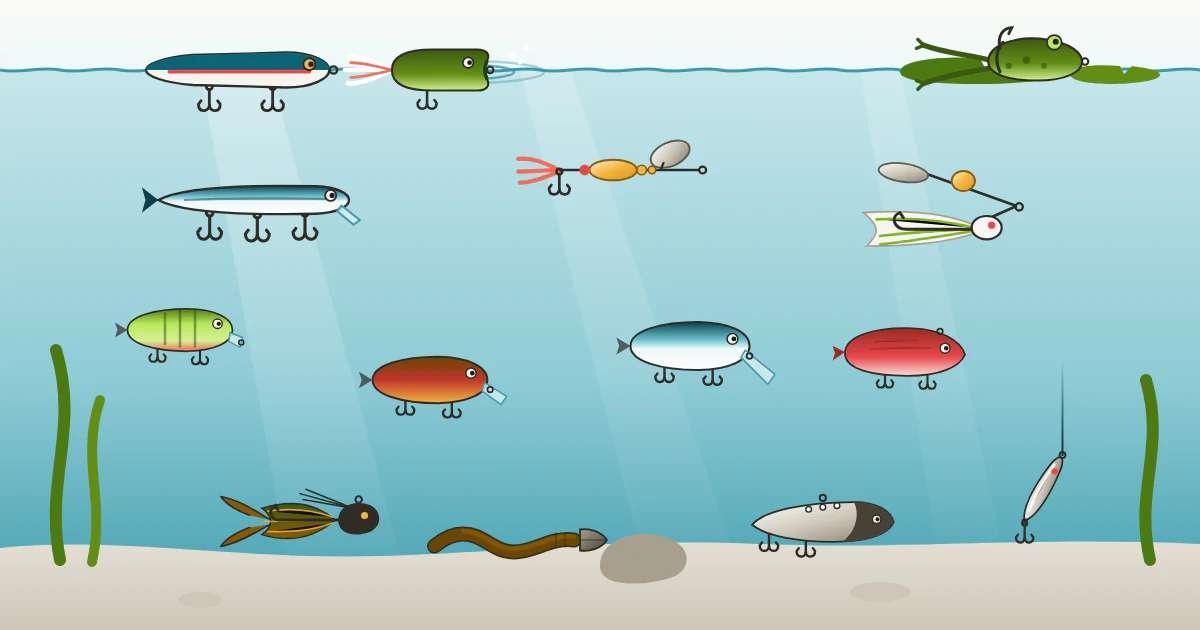
Almost every lure in a tackle shop belongs to one of about a dozen families, and each family is built to work one layer of the water: the surface, the top few feet, the middle or the bottom. Choose the family first, by how deep the fish are and how much cover they are in; color, size and brand come after that. The chart shows where each type runs, how you fish it, what it catches and when to leave it in the box.
Fishing Lure Types Chart

| Lure type | Where it runs | How to fish it | Main targets | In cover? | Leave it in the box when |
|---|---|---|---|---|---|
| Jig | Bottom, any depth (the head weight decides) | Hop, drag or swim; most bites come on the fall | Bass, walleye, perch, crappie | Weedless jigs go into brush, grass and rock | You need to cover a lot of water fast |
| Soft plastics | Wherever the rig puts them: on the bottom, just above it or mid-depth | Slow: crawl, hop, shake | Bass above all; walleye and panfish on small jigs | Yes, Texas-rigged | Fish are chasing bait at the surface |
| Crankbait (lipped) | A set depth, from a foot or two to 16 ft and deeper; the longer the lip, the deeper | Steady retrieve; bump it off bottom and cover | Bass, walleye, pike | Square bills bounce off wood and rock; trebles foul in grass | Thick weeds, or fish deeper than the bait dives |
| Lipless crankbait | Sinks: any depth you count it down to | Steady retrieve, yo-yo, or rip it out of grass tops | Bass | Over submerged grass | Brush and timber (trebles hang up) |
| Jerkbait / minnow bait | Top 2–8 ft | Twitch, twitch, pause; long pauses in cold water | Bass, walleye, pike, trout | No, open water | Fish are glued to the bottom in deep water |
| Spinnerbait | Surface to mid-depth; can be slow-rolled deeper | Steady retrieve | Bass, pike | Yes, wood and sparse grass | Calm, bright days (they shine in wind and clouds) |
| Bladed jig | Shallow to mid-depth | Steady retrieve so the blade makes the head shake | Bass | Through and over grass | Fish are deep and holding on the bottom |
| Inline spinner | Top few feet | Cast across or upstream, retrieve just fast enough to turn the blade | Trout, panfish, smallmouth; pike on big sizes | No | Weedy water, deep fish |
| Spoon | Casting: any depth; jigging: straight down; weedless: over weeds | Cast and wind, or lift and drop | Pike, trout, salmon, bass, walleye | Only weedless models | Snaggy bottom with a treble-hook spoon |
| Blade bait | Bottom, fished vertically or hopped | Short lifts and falls | Smallmouth, walleye | No, rock and open bottom | Warm water, when faster baits work |
| Topwater | Surface | Walk, pop and pause, or buzz steadily | Bass, pike | Frogs go over mats; others need open water | Bright midday sun or rough water |
| Swimbait | Mid-depth or near bottom, by jig head weight | Slow, steady retrieve; the tail does the work | Bass, walleye, pike, stripers | Weedless versions only | Fish want something small and slow |
Water clarity changes which color to tie on, not which type; for that, see our lure color selection chart.
Bottom Lures: Jigs, Soft Plastics and Blade Baits
Jigs
A jig is a hook with a weighted head, dressed with hair, a silicone skirt or a soft-plastic trailer: the head weight sets the depth, the dressing sets the look. Take Me Fishing (opens in a new tab) calls it the bass lure to use in heavy cover. For walleye, 1/8–1/4 oz jigs tipped with a minnow or a soft plastic work in every season (see our best walleye lures); for perch and crappie, go down to 1/32–1/8 oz.
For bass, Keith Combs (Bassmaster (opens in a new tab)) suggests a few styles rather than dozens: a flipping jig for heavy cover, a football jig for offshore structure, whose round head makes the trailer kick up like a defensive crayfish, and a small finesse jig for fussy fish. He avoids hooks bigger than 4/0–5/0 because they hang up more.
Soft plastics
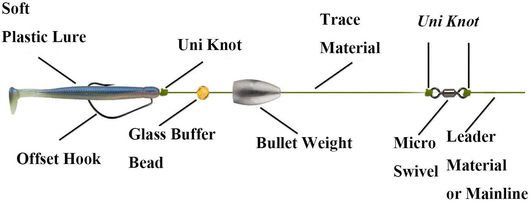
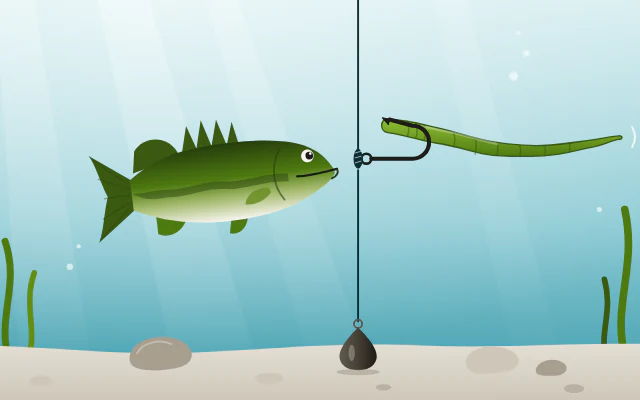
Worms, creature baits, craws, grubs and soft minnows are fished on a rig, and the rig decides how they behave: on a Texas rig the bait crawls through cover, on a Carolina rig it glides above a dragged weight, on a drop shot it hovers in place, on a jig head it swims. Take Me Fishing recommends a Texas-rigged worm as the first bass lure: it is cheap, weedless and hard to fish wrong. Our guides to the Texas and Carolina rigs and the drop shot rig cover the setups.
Blade baits
A blade bait is a thin metal body weighted along the bottom or nose, mostly 1/8–1/2 oz, that vibrates hard when pulled upward. It is a cold-water lure. Smallmouth anglers interviewed by Bassmaster (opens in a new tab) fish it once the water drops under about 50°F in fall, until it climbs back above 50°F in spring, and catch fish on it below 40°F. Lift it only 4–6 inches, enough to feel the vibration, and let it fall back. For river walleye, In-Fisherman (opens in a new tab) rates 1/4 oz as the all-round size, from just above freezing to about 60°F; most strikes come as the blade falls.
Diving Lures: Crankbaits, Lipless Crankbaits and Jerkbaits
Crankbaits
The bill (lip) makes a crankbait dive when you reel and float up when you stop, and its size sets the depth. In Rapala's DT ("Dives-To") series the number is the depth: the DT4 runs at 4 feet, the DT16 at 16 (Rapala spec table (opens in a new tab)). Line and cast length matter too: as David Fritts explains in Bassmaster (opens in a new tab), thinner line lets a crankbait dig deeper, and a longer cast gives it more distance to reach its depth.
For fish on the bottom, pick one that dives a little deeper than the water, so it bumps bottom, rocks and stumps; many strikes come right as it deflects. Square bills are the shallow version, built to bounce off wood and rock. Take Me Fishing notes that crankbaits are strong around wood and rock but a poor choice in grass, where the treble hooks foul on every cast.
Lipless crankbaits
With no lip, these sink and vibrate tightly, so you can count them down to any depth. Their best use is over submerged grass: let the bait tick the grass tops, then rip it free. Andrew Upshaw (opens in a new tab) fishes 1/2 oz models in the fall, when the grass is tall and the bass shallow, and 3/4 oz ones in winter to reach deeper grass edges. The yo-yo retrieve (let it fall to the bottom, sweep it up, reel the slack, repeat) works when fish are near the bottom.
Jerkbaits and minnow baits
Long, slim minnow imitations that run shallow; jerk the rod tip to make them dart, then pause. Floating models rise on the pause (the Rapala Original Floating runs 2 to 6 feet in sizes up to 5 1/4 inches); suspending models hang still, like the Rapala Husky Jerk, which runs 4 to 8 feet in its larger sizes (Rapala spec tables (opens in a new tab)). The colder the water, the longer the pause: Bernie Schultz (Bassmaster (opens in a new tab)) says to slow the cadence as the bite slows, with pauses of 30 seconds or more in cold water.
Blade and Wire Lures: Spinnerbaits, Bladed Jigs and Inline Spinners
Spinnerbaits
A bent wire with a jig head and skirt on the lower arm and one or two spinning blades on the upper arm. The wire shields the hook, so it comes through wood and sparse grass. Blades decide the character, according to Bass Pro Shops (opens in a new tab):
- Willow: long and thin, lots of flash, little resistance; suits fast retrieves.
- Colorado: round, moves the most water and thumps; can be retrieved slowly, which suits cold water and night fishing.
- Indiana: between the two.
Take Me Fishing adds that spinnerbaits tend to work best in shallow water on windy, cloudy days, with willow blades in clear water and Colorado blades in muddy water.
Bladed jigs
A skirted jig with a hexagonal metal blade on its nose; the line ties to the blade, and the whole lure shakes as you wind it. The original Z-Man ChatterBait comes in 1/4, 3/8 and 1/2 oz with a 5/0 hook (Z-Man (opens in a new tab)). Fish it on a steady retrieve around and through grass, often with a soft-plastic trailer.
Inline spinners
A blade that turns around a straight wire shaft, with a weighted body and usually a treble hook. Small ones are classic stream-trout and panfish lures: Worden's Rooster Tail, for example, is made from 1/16 to 1/4 oz (Yakima Bait (opens in a new tab)). In streams, cast across or slightly upstream and reel just fast enough to keep the blade turning. For line, see our best fishing line for trout.
Spoons
Curved metal that wobbles and flashes. Casting spoons such as the Acme Kastmaster (made in 1/8, 1/4 and 3/8 oz, among other weights) cast a long way and can be counted down to any depth. Jigging spoons are heavier and narrower, lifted and dropped straight down over deep fish, through the ice or from a boat. Weedless spoons have a single hook behind a wire guard and are pulled over and through weeds for pike and bass. Trolling spoons are thin and light and need a downrigger, planer board or diver to get deep.
Surface Lures: Topwater and Frogs
Topwater lures float and are worked on the surface. According to Take Me Fishing, they work best in low light and calm water, around docks and brush:
- Walking baits (pencil baits). Twitch the rod tip on slack line and the lure glides left and right. The Heddon Zara Spook, 4 1/2 inches and 3/4 oz, is the lure credited with creating the "walk the dog" retrieve (Heddon (opens in a new tab)).
- Poppers. A cupped face spits water when you jerk it; pause between pops. The Rebel Pop-R is 2 1/2 inches and 1/4 oz (Rebel (opens in a new tab)).
- Buzzbaits. A wire bait with a propeller-like blade that churns the surface on a steady retrieve; covers water fast.
- Hollow-body frogs. Soft, with upturned double hooks tucked against the body, so they slide over lily pads and matted grass where most lures can't be fished. The SPRO Bronzeye Frog 65 is 5/8 oz with a 4/0 double hook (SPRO (opens in a new tab)). Use heavy braid: you have to drag the fish out of the vegetation.
How to Choose the Right Lure Type
- Where are the fish in the water column? Surface: topwater. Top few feet: jerkbait, spinnerbait, shallow crankbait, inline spinner. Middle: crankbait, lipless, swimbait. Bottom: jig, soft plastics, blade bait, jigging spoon.
- How much cover? In grass, wood and brush, use weedless lures: Texas-rigged plastics, jigs, spinnerbaits, frogs, weedless spoons. Treble hooks belong in open water.
- How active are the fish? Warm water and feeding fish: fast lures that cover water. Cold water or fish that have stopped chasing: slow ones that stay in front of them, such as a jig, a drop shot or a paused jerkbait.
- What are they eating? Match the size and shape of the local baitfish or crayfish before you worry about exact color.
- Can your rod cast it? Rods list a lure weight range on the blank: a 1/16 oz spinner needs light spinning gear, a 3/4 oz lipless or a frog a heavier rod, often a baitcaster (see baitcasting vs. spinning reels).
A Small Starter Box by Target Fish
| Target | Start with |
|---|---|
| Largemouth bass | Texas-rigged worm, spinnerbait, square-bill crankbait, a jig, a popper or frog |
| Smallmouth bass | Drop shot with a small plastic, jerkbait, tube or small jig, blade bait for cold water |
| Walleye | 1/8–1/4 oz jigs with minnows or plastics, a stickbait, a crankbait for trolling, a blade bait or jigging spoon |
| Northern pike | Spinnerbait, weedless spoon, large jerkbait, swimbait, and a wire or heavy fluorocarbon leader |
| Trout in streams | 1/16–1/8 oz inline spinners, small spoons, small floating minnow baits |
| Perch and crappie | 1/32–1/8 oz jigs with small plastics, small spinners; see how to catch perch |
Common Mistakes
- Fishing the wrong depth. When the fish are on the bottom in 12 feet of water, a crankbait rated for 6 feet runs over their heads all day. Check the rated depth and pick one that reaches them.
- Treble hooks in heavy cover. If you are pulling weeds off every cast, switch to a weedless lure instead of casting the same one again.
- Retrieving too fast in cold water. Slow down, pause longer, or change to a lure that works in place.
FAQ
What are the main types of fishing lures?
Jigs, soft plastics, crankbaits (lipped and lipless), jerkbaits, spinnerbaits and bladed jigs, inline spinners, spoons, blade baits, topwater lures and swimbaits. Fly anglers add flies, which are cast with fly tackle.
What is the difference between a crankbait and a jerkbait?
A crankbait has a lip that makes it dive and wobble on a steady retrieve. A jerkbait is longer and slimmer, usually runs shallower, and is fished with twitches and pauses; suspending models hang motionless between twitches.
What is the best lure for a beginner?
For bass, a Texas-rigged soft-plastic worm. For panfish, trout and bass in small waters, a small inline spinner. Both are cheap and simple to fish.
Sources
- Take Me Fishing: Bass fishing lures (opens in a new tab) and Freshwater fishing lures (opens in a new tab)
- Rapala: DT series (opens in a new tab), Husky Jerk (opens in a new tab), Original Floating (opens in a new tab) (spec tables)
- Bassmaster: How crankbait running depth works (David Fritts) (opens in a new tab)
- Bassmaster: Knowing when to jerk (Bernie Schultz) (opens in a new tab)
- Bassmaster: Blade baits for winter smallies (opens in a new tab)
- Bassmaster: Ripping traps in grass (Andrew Upshaw) (opens in a new tab)
- Bassmaster: The beginner's guide to jigs (Keith Combs) (opens in a new tab)
- Bass Pro Shops: Spinnerbait buying guide (opens in a new tab)
- In-Fisherman: Spring river walleyes on blade baits (opens in a new tab)
- Manufacturer pages: Z-Man ChatterBait (opens in a new tab), Rooster Tail (opens in a new tab), Acme Kastmaster (opens in a new tab), Heddon Zara Spook (opens in a new tab), Rebel Pop-R (opens in a new tab), SPRO Bronzeye Frog 65 (opens in a new tab)
Related fishing reports
Largemouth Bass fishingSmallmouth bass fishingWalleye fishingNorthern Pike fishing