On this page 10 sections
We analyzed 4,895 verified northern pike catches with a catch date, logged on pinfishing.com and our Lithuanian sister site, kimba.lt. Pike were caught in every month, and in every season at least 86% of the catches with a logged time came between 6 a.m. and 9 p.m. The busiest 3-hour slot was noon–3 p.m. in winter, 3–6 p.m. in fall and 6–9 p.m. in spring and summer. Soft plastics and hard baits together took 62% of the catches with a public bait.
Quick answer: fish weedy water and quiet backwaters with a soft plastic or a hard bait on a wire leader. In our log only 6% of fall and 4% of winter catches with a logged time came before 9 a.m.; in spring and summer the busiest slot was 6–9 p.m. Strike as soon as a pike takes the bait, and unhook it on a mat with long forceps.
When Is the Best Time of Year to Catch Pike?
May is the top month in our log with 933 pike, then October (746) and September (634). February and March have the fewest: 39 and 38.

The heaviest monthly averages came late in the year and in midsummer: 3.17 kg (7.0 lb) in November, 3.15 kg (6.9 lb) in July and 3.00 kg (6.6 lb) in December. May, the busiest month, averaged 2.60 kg (5.7 lb).
Note: these numbers show when our anglers caught and logged pike, not why more pike were caught in one month than in another. Closed seasons also decide when you may fish for pike: in Lithuania, where most of our catches with a known water come from, pike may not be caught from February 1 to April 30 under the current rules.
What Time of Day Do Pike Bite?
Of the 3,723 catches with a logged time slot, the pattern changes with the season. Times are local, as the anglers logged them, and most catches with a known water are from Lithuania.
- Winter (December–February): 74% between 9 a.m. and 3 p.m., only 4% before 9 a.m.
- Fall (September–November): 59% between noon and 6 p.m., 6% before 9 a.m.
- Spring (March–May): the busiest slot is 6–9 p.m. with 26%; the three daytime slots from 9 a.m. to 6 p.m. have 19–21% each.
- Summer (June–August): also busiest at 6–9 p.m. (25%), with 13% at 6–9 a.m. and 11% from 9 p.m. to midnight.

Tip: planning a short fall or winter trip? In our log, 77% of fall and 94% of winter pike with a logged time came between 9 a.m. and 6 p.m., so plan for those hours; in spring and summer, give the evening a try. The log shows when anglers caught pike, and that also depends on when they were out fishing.
If you fish for pike in summer, check the water temperature first. The Pike Anglers' Club of Great Britain recommends not fishing for pike at all when the water is 18 °C (64 °F) or warmer, and warns that at dawn, when the water is coolest, dissolved oxygen can be at its lowest.
Where to Find Pike
FishBase describes adult pike as fish of "clear vegetated lakes, quiet pools and backwaters" of creeks and rivers, usually solitary, and gives a usual depth of 1–5 m (3–16 ft). Adults feed mainly on fish, and at times feed heavily on frogs and crayfish. To spawn, pike move inshore or upstream to marshy areas: the Alaska Department of Fish and Game says they spawn in spring soon after the ice goes out, on the grassy margins of lakes, slow streams and sloughs.
Tip: on a new lake, start in weedy bays and along weed beds in quiet water, the kind of habitat FishBase describes.
For recent catches, see our northern pike fishing page.
Best Lures and Baits for Pike
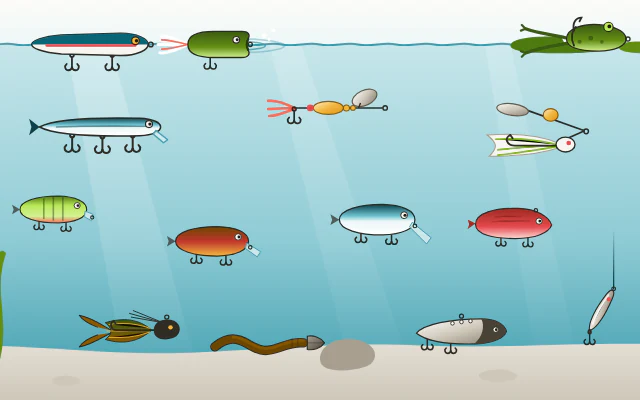
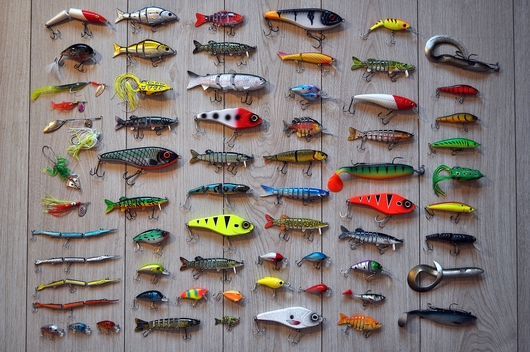
Of our pike catches, 3,009 have a public bait. Soft plastics (shads, twisters) lead with 38%, followed by hard baits—crankbaits, jerkbaits and other plugs, logged on our site as "wobblers"—at 24% and live or dead fish at 16%. Spoons took 8% and spinners 7%.

The mix changes with the season. In winter live or dead fish were the top bait (38%), and ice jigs and soft plastics took 20% each. In spring soft plastics had their biggest share, 45%. Summer is the only season where spoons and spinners each reached 10%.
Of the 3,363 catches with a logged method, 1,863 (55%) came on spinning gear—casting and retrieving a lure. Trolling follows with 298, jigging with 261, twitching with 230, live bait with 163 and float fishing with 144.
If you fish natural baits, the Pike Anglers' Club names mackerel, herring, sardines and sprats (small herring-like fish) as good dead baits, and says to use live baits only where they are allowed—check local rules first.
Tip: if you are new to pike, start with what caught most of our fish: a soft plastic (for example on a jig head) or a hard bait, cast and retrieved. Change the speed and add pauses before you change the lure. Our guide to lure types shows where each type runs, and the lure color chart helps you pick a color.
Do You Need a Wire Leader for Pike?
Yes. The Alaska Department of Fish and Game notes that a pike's jaws, the roof of its mouth, its tongue and gill rakers carry many sharp teeth. The Pike Anglers' Club of Great Britain says a wire leader (a "trace" in British usage) must be used whenever you fish for pike, because even small pike can cut through ordinary nylon line. The club does not endorse mono or fluorocarbon leaders.
The club's basic pike fishing leaflet (2024) recommends:
| Item | Pike Anglers' Club recommendation |
|---|---|
| Wire leader | 18 in or longer (45 cm in the club's 2004 fact sheet), at least 30 lb for bait fishing; shorter leaders are acceptable for lure fishing and for live baiting with an uptrace (a second wire length above the leader) |
| Uptrace | Good practice when bait fishing |
| Main line | At least 18 lb mono or 65 lb braid as an all-round guide; heavier braid for big lures |
| Hooks | Semi-barbless or crushed-barb, sizes 4 to 6 |
| Bite indication (bait fishing) | A float, drop-off indicator or bite alarm; never freeline (fish a bait with no float or indicator) |
| Striking | Strike immediately when a pike takes the bait; a delayed strike risks a gut-hooked pike |
Choosing a reel for heavy pike lures and braid? Our baitcasting vs. spinning reel comparison covers the trade-offs.
How Much Does a Pike Weigh? Length-to-Weight Chart
We have 1,378 catches with a usable length (30–150 cm) and weight (0.2–25 kg). Grouped in 10 cm bands, the middle (median) fish weighed:

The median 70–79 cm (28–31 in) pike weighed 2.8 kg (6.1 lb), and the median meter-long fish (100–109 cm, 39–43 in) 7.8 kg (17.2 lb). Within one 10 cm band, weights spread: in the 80–89 cm (31–35 in) band the middle half weighed 3.7–4.5 kg (8.2–9.9 lb).
The heaviest verified pike in our log weighed 16.5 kg (36 lb 6 oz) and measured 125 cm (49 in). It was caught trolling a wobbler on the Leitė River in Lithuania on October 25, 2014 and logged in 2017. For scale, FishBase gives a maximum length of 150 cm (59 in) for females and a maximum published weight of 28.4 kg (62.6 lb), and the Pike Anglers' Club lists the British rod-caught record at 47 lb 5 oz (21.5 kg), from Chew Valley Lake in February 2024.
How to Handle and Release a Pike
Our anglers released 1,417 of the 2,610 pike (54%) whose catch record says whether the fish was kept or let go. If you release yours, the Pike Anglers' Club advises:
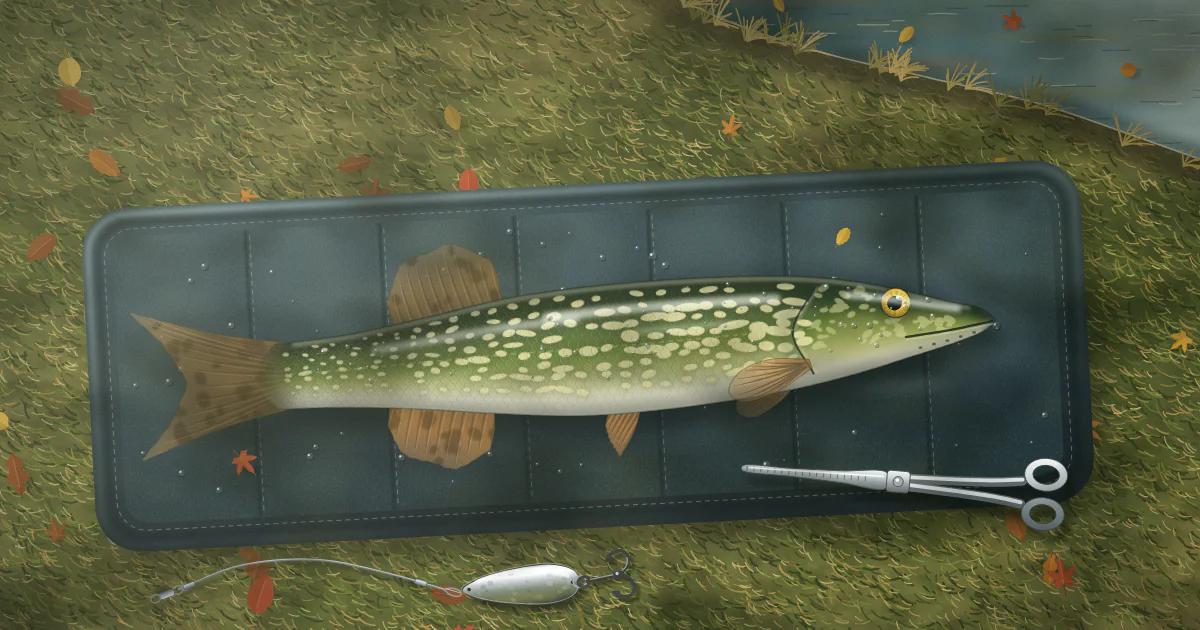
- Bring the right gear: a large knotless landing net (a triangle net with 42-inch or longer arms, or an oval net of, for example, 85 × 70 cm), a large unhooking mat or cradle, forceps or long-nose pliers at least 10 inches long, and long-reach wire or side cutters.
- Unhook on the mat, never on bare hard ground. Lay the pike on its back and hold the lower jaw through the gill cover, keeping clear of the gill rakers, while the other hand works the hooks out with the forceps.
- No gags or lip grips: the club says never to use a pike gag or Boga Grips, and to weigh the fish in a sling, not on a scale hook under the chin.
- Keep it wet: don't leave the pike out of the water while you set up a camera.
- Release only a recovered fish: support it in the water until it can hold itself upright and swim off strongly.
Pike Seasons and Size Limits Differ by Country
There is no single pike rule. Two examples show how far apart they can be:
| Where | Closed season | What you may keep |
|---|---|---|
| Lithuania, inland waters | No pike from February 1 to April 30 | 50–80 cm only, at most 2 pike per fishing trip; exceptions apply on some waters |
| England | No coarse fishing on rivers, streams and drains from March 15 to June 15; most lakes, ponds and canals are open all year | From rivers, 1 pike up to 65 cm a day; local byelaws add their own rules |
GOV.UK lists pike among coarse fish. Even measuring differs: in England you measure a fish from the tip of the snout to the fork of the tail; in Lithuania, to the end of the tail fin. Wales has its own rules: see the Natural Resources Wales angling byelaws (opens in a new tab).
Important: check the rules for your own water before you go: in the US and Canada, the state or provincial regulations; in Europe, the national rules and any local permits.
Pike Fishing FAQ
What is the best month to catch pike?
In our log, May (933 catches) and October (746). The fish averaged heavier in October (2.94 kg, 6.5 lb) than in May (2.60 kg, 5.7 lb).
What size wire leader do you need for pike?
The Pike Anglers' Club recommends at least 18 inches (its 2004 fact sheet gives 45 cm) and, for bait fishing, at least 30 lb; shorter leaders are acceptable for lures.
How much does a 1-meter pike weigh?
In our catches, the median pike of 100–109 cm weighed 7.8 kg (17.2 lb).
Before your next trip, check the closed season for your water and pack a wire leader, a mat and long forceps. Caught one? Log your catch: it goes into next year's numbers.
Note on the data: verified pike catches with a catch date in the shared pinfishing.com and kimba.lt catch log on September 29, 2026: 4,895 of the 5,365 verified pike catches, from 1959 to 2026, 82% of them from 2014–2018. Of these, 2,553 are linked to a water body, and 2,331 of those are in Lithuania. Seasons: winter December–February, spring March–May, summer June–August, fall September–November. Average weights leave out weights outside 0.1–25 kg; the length chart uses catches with a length of 30–150 cm and a weight of 0.2–25 kg. Times, methods, lengths and baits count only where the angler entered them, baits only where they were made public. Numbers are rounded half up from the unrounded values, so a text and a chart figure can differ in the last digit.
Sources
- pinfishing.com / kimba.lt catch log, verified pike catches, queried September 29, 2026
- FishBase: Esox lucius, northern pike (opens in a new tab) (size, habitat, food, spawning; accessed September 29, 2026)
- Alaska Department of Fish and Game: Northern pike species profile (opens in a new tab) (accessed September 29, 2026)
- Pike Anglers' Club of Great Britain: Basic pike fishing leaflet (opens in a new tab) (PDF, 2024; accessed September 29, 2026)
- Pike Anglers' Club: Fact sheet 1, Trace and rig basics (opens in a new tab) (PDF, 2004; accessed September 29, 2026)
- Pike Anglers' Club: Fishing for pike (handling) (opens in a new tab) and Warm water piking guide (opens in a new tab) (accessed September 29, 2026)
- GOV.UK: Freshwater rod fishing rules (opens in a new tab) (accessed September 29, 2026)
- Natural Resources Wales: Angling byelaws (opens in a new tab) (accessed September 29, 2026)
- Lithuania: Amateur fishing rules for inland waters (opens in a new tab) (Mėgėjų žvejybos vidaus vandenyse taisyklės, consolidated version in force from May 14, 2026; points 6, 11.1.9 and 11¹.8; accessed September 29, 2026)