On this page 11 sections
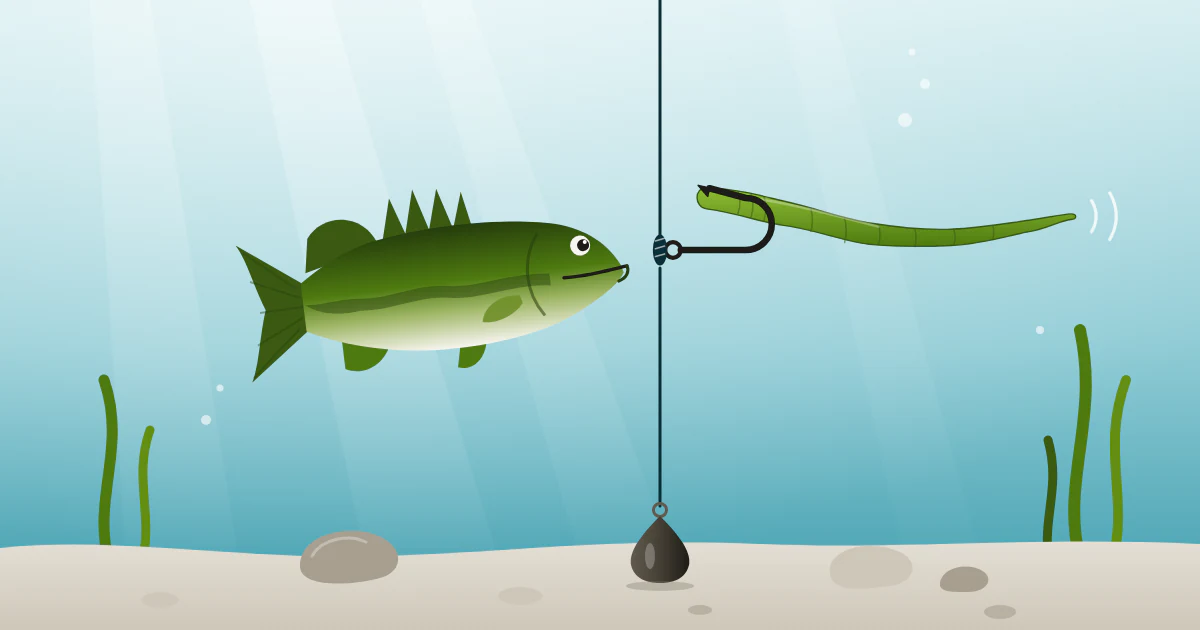
A drop shot rig puts the sinker at the very end of the line and the hook a foot or so above it. The weight sits on the bottom and the bait hangs at a set height above it, where you can shake it in place without dragging it into the rocks. It is the rig for bass, walleye or perch that show up on the sonar near the bottom but won't chase a jig or a crankbait.
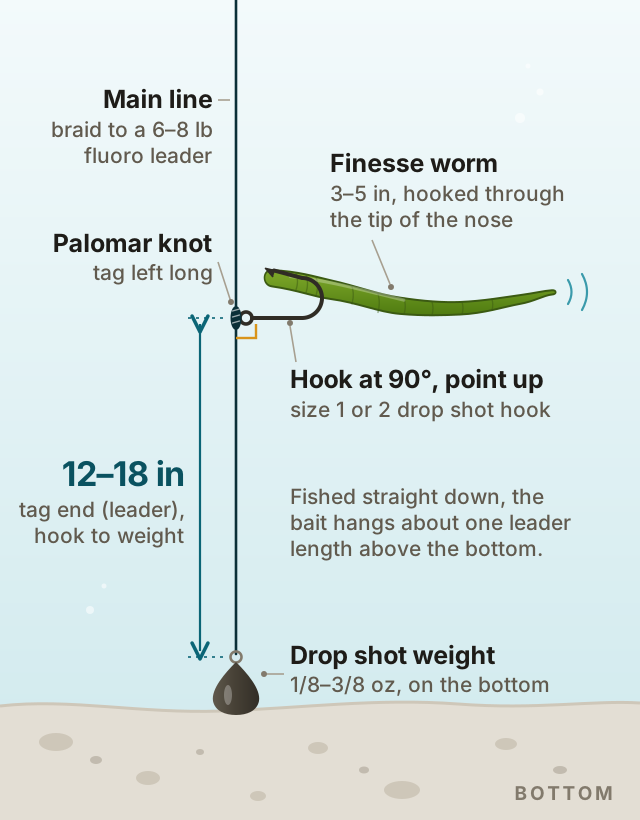
Quick setup: a medium-light spinning rod of about 7 feet, 8–10 lb braid with a 6–8 lb fluorocarbon leader (or straight 6–8 lb fluorocarbon), a size 1 or 2 drop shot hook tied with a Palomar knot, a 3- to 5-inch finesse worm or minnow bait hooked through the nose, and a 1/8–3/8 oz weight 12–18 inches below the hook.
How a Drop Shot Works
On a Texas or Carolina rig the bait is either on the bottom or trailing just above it, and it only moves when you move the whole rig. On a drop shot the weight anchors the rig and the bait moves on its own: with the sinker on the bottom, small shakes of slack line make the bait quiver and settle without going anywhere.
The leader (the line between hook and weight) sets that depth, but only fully when you fish straight down. Once you cast, the line angle pulls the bait lower. Kevin VanDam has pointed out that an 18-inch leader cast into about 10 feet of water holds the bait only 4 or 5 inches off the bottom (Bassmaster (opens in a new tab)). If you want the bait higher on a cast, tie a longer leader; if you fish vertically, the leader length is roughly the height of the bait.
How to Tie a Drop Shot Rig
The hook is tied with a Palomar knot, and the long tag end becomes the leader:
- Double the line and push the loop through the hook eye, with the hook point facing up. Pull through enough to leave the tag you want as a leader plus a few inches for the weight (Take Me Fishing's instructions call for 10 to 36 inches).
- Tie a loose overhand knot with the doubled line, with the hook hanging in the middle of it.
- Pass the loop over the hook, then wet the knot and pull on both the main line and the tag end to tighten it. Do not trim the tag.
- Thread the tag end back through the hook eye, from the side the point faces, so it exits on the other side and runs down. Pulling it tight makes the hook stand out at 90 degrees to the line.
- Check the hook. Hold the rig by the main line with the tag hanging down: the point should face up. If it faces down, pull the tag out and pass it through the eye from the other side.
- Add the weight to the end of the tag. Most drop shot weights have a line clip: slide the line in and it holds without a knot, and you can move the weight to change the leader length. A bell sinker needs a knot.
- Hook the bait (see below).
Drop Shot Setup: Rod, Line, Hook and Weight
| Component | What to use | Why |
|---|---|---|
| Rod | 6'6"–7'4" medium-light or medium spinning rod, fast tip | Bass Pro's rigging guide lists 6–7 ft rods; Matt Lee uses 7'4" to pick up slack on long casts |
| Reel | 2500- or 3000-size spinning reel, smooth drag | Casts light weights, protects light leaders |
| Main line | 8–12 lb braid | Feel in deep water; the pros quoted by Bassmaster use 8, 10 and 12 lb |
| Leader | 6–8 lb fluorocarbon, several feet long, joined with a line-to-line knot or a small barrel swivel; or straight 6–8 lb fluorocarbon in very clear water | Low visibility near the bait; Justin Lucas goes up to 10 lb around shallow cover |
| Hook | Size 2 or 1 drop shot hook for nose-hooked 3–5 in baits; 1/0–2/0 offset or straight-shank to Texas-rig in cover; size 2–6 octopus for live bait | Light wire sets with the pressure 6–8 lb line allows |
| Weight | 1/8–3/8 oz; 1/2 oz in deep current | Enough to hold bottom, no more |
Two hooks made for the rig: the Gamakatsu Split Shot/Drop Shot hook (sizes 4 to 3/0) and the VMC SpinShot (sizes 8 to 2/0), which has a swivel through the eye so the hook turns freely and undoes line twist. Braid, leaders and pound tests are covered in more detail in our best fishing line for walleye guide.
Which weight: depth, wind and current
Bassmaster's reporting on how tournament anglers weight their drop shots gives a useful range:
| Situation | Weight | Example |
|---|---|---|
| Shallow, about 4–10 ft | 3/16–1/4 oz | Justin Lucas: 3/16 oz around cover in 4–8 ft; VanDam: 3/16 or 1/4 oz in 5–10 ft of current |
| Up to about 15 ft | 1/4 oz | Matt Lee's starting point below 15 ft |
| 25–30 ft | 3/8 oz | Lee, in most situations at that depth |
| Deep water with current, or wind | 3/8–1/2 oz | VanDam in about 30 ft of river current |
| Suspended fish | 1/8–1/4 oz | Kotaro Kiriyama: 1/8 oz for bass suspended 20 ft down in cold water, to slow the fall; 1/4 oz for bass suspended 50 ft down |
Lee's rule: use the lightest weight that still lets you feel the drop shot. He uses slim lead cylinders in vegetation, where a teardrop collects weeds, and tungsten teardrops on rock, where they slip through gaps and transmit more feel.
Leader length: hook to weight
| Where the fish are | Leader |
|---|---|
| Right on the bottom, for example feeding on crayfish | 4–10 in |
| Not sure; a starting point | 12–18 in |
| Suspended above the bottom, over weeds or moss, fall | 18–36 in |
These ranges come from the anglers above (VanDam shortens the leader when bass feed on crayfish near the bottom; Aaron Martens fished 4–10 inches in spring and 15–20 in fall; Kiriyama and VanDam used 12 inches in the examples above) and from In-Fisherman (opens in a new tab), which puts walleye rigs 12 to 16 inches above the weight and up to three feet. Tie the tag longer than you need: the weight clip slides, so you can shorten it on the water.
Best Drop Shot Baits and How to Hook Them
- Nose-hooked finesse baits. Straight-tail worms of 4–6 in and minnow-shaped plastics of 3–4 in are the standard. Push the hook through the very tip of the nose so the bait hangs straight and moves freely. Brandon Palaniuk pushes the point in from the underside and out through the nose rather than from the top, which he says keeps the bait from pivoting and spinning on the hook.
- Wacky-hooked. A short stick worm or a small wacky worm hooked through the middle gives both ends a flutter when you shake it.
- Texas-rigged. With a 1/0–2/0 offset hook and the point buried in the plastic, the bait comes through brush and sparse grass. VanDam and Kiriyama both switch to this in snaggy cover.
- Live bait. Leeches, lip-hooked minnows and nightcrawlers on a size 2–6 octopus hook are deadly for walleye and perch. Check your state or provincial rules on live bait and never move bait or fish between waters.
Natural colors (green pumpkin, watermelon, shad) cover most clear water; our lure color selection chart explains when to switch to brighter or darker ones.
How to Fish a Drop Shot
Vertical: from a boat or through the ice
Find fish or structure on the sonar, drop the rig straight down and let the weight touch bottom. Reel until the line is just tight, then shake the rod tip a few inches so the line goes slack and tight again: the weight stays put, the bait twitches. Pause often, and watch the line on the way down; Kiriyama's suspended Lake Erie smallmouth hit the bait as it sank past them.
Casting and dragging
Cast to a point, ledge, rock pile or weed edge and let the weight settle. Shake the bait in place, drag the weight a foot or two with a sideways sweep of the rod, and repeat. Brent Ehrler has found fish that hit a dragged drop shot and ignored one shaken in place, so try both.
Deadsticking
When fish are sluggish, do almost nothing. Martens would let the bait rest for 10 to 20 seconds after the weight touched down before lifting it slightly, without moving the weight.
Setting the hook
A small light-wire hook does not need a big overhead jerk, and 6–8 lb line may not survive one. When you feel a bite, reel until the line is tight and sweep the rod firmly to the side, with the drag set to slip before the leader breaks.
Drop Shot vs. Texas Rig vs. Carolina Rig
| Drop shot | Texas rig | Carolina rig | |
|---|---|---|---|
| Weight position | At the end of the line, below the bait | Against the bait | 18–36 in above the bait |
| Bait position | At a set height above the bottom | On the bottom | Trailing just above the bottom |
| Best for | Pressured or inactive fish, suspended fish, rock and sparse weeds | Heavy cover: grass, wood, docks | Covering open structure fast |
| Speed | Slowest; can stay in one spot | Slow to medium | Medium; searches |
| Typical line | 6–8 lb fluorocarbon leader, often on braid | 12–20 lb fluorocarbon or heavy braid | 15–20 lb main line, 10–15 lb leader |
The Texas and Carolina columns come from our Texas rig vs. Carolina rig guide. Our baitcasting vs. spinning reel guide explains why light finesse rigs like this one belong on spinning gear.
When Not to Use a Drop Shot
- Heavy cover. Matted grass, thick brush and laydowns eat an exposed hook and a dangling weight. Flip a Texas rig or a jig instead.
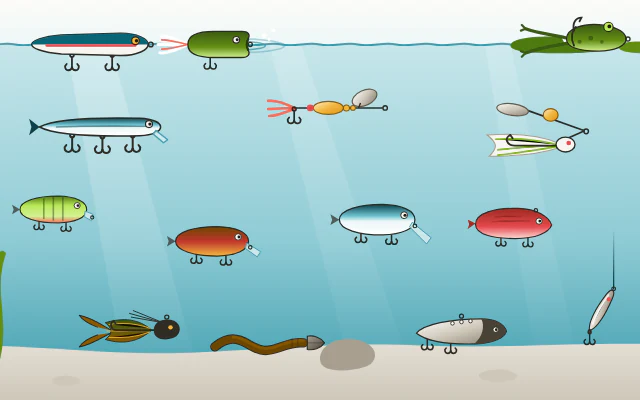
- Searching. The drop shot is slow by design. To find fish on a big flat or a long point, cover water with a Carolina rig, a crankbait or a spinnerbait first; our chart of fishing lure types shows what each one does.
- Active, shallow fish. When bass are chasing bait near the surface, a moving lure usually catches them faster.
- Big fish in cover on light line. 6 lb fluorocarbon will not pull a big bass out of a brush pile. Use heavier line and a Texas rig there.
Drop Shotting for Walleye, Perch and Panfish
For walleye, In-Fisherman suggests 4–6 lb low-visibility line in clear water, size 2–6 octopus hooks, 1/4–1/2 oz bell sinkers on deep structure and live bait: leeches, lip-hooked minnows or crawlers. It singles out fussy fish, snaggy or mossy bottoms and fish suspended off the bottom as situations where the drop shot shines.
For yellow perch in deeper summer water, the rig keeps a minnow or a piece of crawler right where a school is feeding; our guide on how to catch perch covers where to find them and why size 6–8 hooks suit their small mouths. Through the ice, Gord Pyzer (Outdoor Canada (opens in a new tab)) sets the hook one to two feet above a 1/4 oz or heavier tungsten weight, with size 2–6 hooks for walleye, sauger, jumbo perch and trout and size 8–12 for crappies and bluegills.
Common Mistakes and How to Fix Them
- Line twist. A nose-hooked bait that isn't straight spins on every retrieve. Re-rig it straight, use a swivel hook such as the SpinShot, or put a small barrel swivel between the main line and the leader, as VanDam does, 2 or 3 feet up the line.
- Too heavy a weight. The rig snags more and you lose feel. Go down until you can just feel the bottom.
- Moving the weight when you shake. Shake the slack, not the line: if the weight is hopping, you are fishing a jig.
- A hook too big for the line. Skeet Reese warns that 4/0 and 5/0 hooks have too thick a wire to set on 8 lb line with spinning gear. Stay at 2/0 or smaller.
Drop Shot FAQ
How long should a drop shot leader be?
Start at 12–18 inches from hook to weight: shorter for fish on the bottom, up to 2–3 feet for suspended fish or over weeds. On a long cast the bait sits lower than the leader length.
What size hook do you use for a drop shot?
Size 1 or 2 for nose-hooked 3–5 inch plastics, 1/0–2/0 offset to Texas-rig a bigger worm, size 2–6 octopus hooks for live bait.
What pound line is best for drop shotting?
6–8 lb fluorocarbon as a leader on 8–12 lb braid, or as a straight line in very clear water. For walleye in clear lakes, In-Fisherman goes as light as 4–6 lb.
Can you drop shot from shore?
Yes: cast, let the weight settle, shake, drag a short distance and repeat. A slightly longer leader makes up for the line angle from the bank.
Sources
- Take Me Fishing: How to tie a drop shot knot (opens in a new tab)
- Bass Pro Shops: Drop shot rigging (opens in a new tab)
- Bassmaster: Rigging considerations for drop shotting (Kevin VanDam) (opens in a new tab)
- Bassmaster: How Matt Lee chooses drop shot weights (opens in a new tab)
- Bassmaster: 5 must-know drop shot tactics (opens in a new tab)
- Bassmaster: Drop shot tips from the pros (opens in a new tab)
- In-Fisherman: Drop-shotting for walleyes (opens in a new tab)
- Outdoor Canada: Drop-shotting for walleye, trout, perch and panfish (Gord Pyzer) (opens in a new tab)
- Gamakatsu: Split Shot/Drop Shot hook (opens in a new tab) and VMC: SpinShot drop shot hook (opens in a new tab)
Related fishing reports
Smallmouth bass fishingLargemouth Bass fishingWalleye fishingYellow perch fishing